









You've settled on orange and purple for the roofline. Good choice: the two colours sit far enough apart that each one reads clearly after dark. The next decision is the one people tend to skip, and it's the one neighbours notice: the order the bulbs go in.
This guide compares four patterns for an orange and purple bulb run (alternating, paired, colour blocks and accents), shows how to count bulbs for each, and gives you a quick way to test the look before you clip a single socket to the house.
Start with the street view
Patterns behave differently depending on how far away people are. From the sidewalk, someone sees individual bulbs. From across the street or a passing car, bulbs start to merge, and a busy pattern can blur into one in-between colour. So before you pick, ask where most people will see your house from: the front walk, the road, or the end of the block.
It also helps to pick your anchor point. That's the spot the eye lands on first, usually the main peak above the door or the centre of the longest eave. Whatever pattern you choose, start it there and work outward. A pattern that's centred on the peak looks planned. A pattern that starts at a random corner and happens to land unevenly at the peak looks accidental.
Pattern one: alternating
Orange, purple, orange, purple. This is the classic two-colour roofline and the easiest to install, because you never have to count a sequence longer than two.
Up close it looks lively. From farther away, alternating bulbs can soften toward a mixed glow, which some people love and others find muddy. If your house sits close to the sidewalk and most of your audience is on foot (hello, trick-or-treaters), alternating is a strong default.
One detail: if your run has an odd number of sockets, an alternating pattern starts and ends on the same colour. That's actually tidy, because both ends match.
Pattern two: pairs
Two orange, two purple, repeated. Pairs give each colour a little more room to register, so the pattern stays readable from farther back than strict alternating. It feels slightly more deliberate too, almost like a stripe.
Pairs need more care at peaks and corners. Plan so a pair isn't split awkwardly across the very top of a gable. If the numbers don't work out, it's fine to let the peak bulb be a single colour and restart the pairs on each side.
Pattern three: colour blocks by roof section
Instead of mixing along one line, give each part of the house its own colour: orange along the main eave, purple on the garage or the upper gables. Blocks read clearly from the road because each colour gets a whole section to itself.
This works best on houses with a natural break in the roofline, like a garage set back from the main house or a second storey stepped behind the first. On a single long, flat eave, a hard switch halfway along can look like you ran out of one colour, so choose a break the architecture already gives you.
Pattern four: one base colour with accents
Pick one colour for most of the run and use the other only at key points: each peak, each corner, or the stretch right above the front door. For example, a purple roofline with orange at every peak makes the shape of the house pop without looking busy.
Accents are also a nice way to bring in a third colour if you want one. A few green bulbs at the very top of each peak, against an orange and purple line, adds a bit of mischief without turning the roof into a rainbow. Keep a third colour sparse, though. Once it shows up everywhere, it's no longer an accent.
Counting bulbs for your pattern
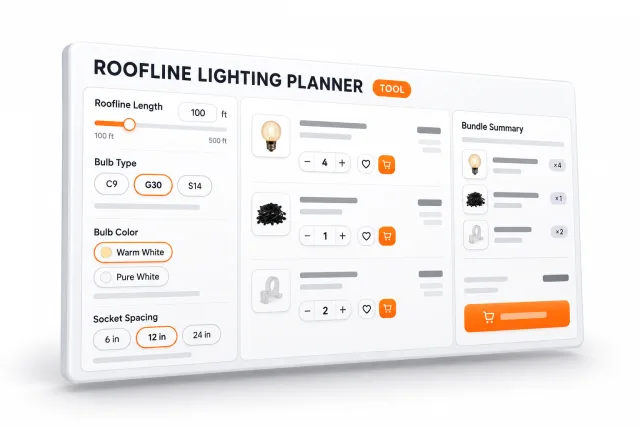
Bulbs like the G30 globe bulb come in packs of 25, and socket wire such as an E17 socket power cord is commonly used with 12-inch spacing on rooflines. At 12-inch spacing you get roughly one socket per foot, so a 100-foot run has about 100 sockets. (Our spacing and density guide explains why 12 inches is the usual choice.)
Here's how a 100-socket run would split for each pattern. Treat these as planning numbers; your actual socket count depends on your cord length and spacing.
| Pattern | Orange | Purple | Planning note |
|---|---|---|---|
| Alternating | About 50 | About 50 | Even split; easiest to install |
| Pairs | About 50 | About 50 | Even split; plan the peaks first |
| Colour blocks | Depends on section lengths | Depends on section lengths | Measure each section separately |
| Accents | A handful at peaks and corners | The rest | Count peaks and corners first |
If you'd rather not count at all, the Halloween Roofline Bundle (100 ft) puts orange and purple G30 bulbs together with socket wire, clips, a timer and connection parts for one planned run. Check the bundle page for the current contents before you plan an uneven split. You can also browse the full Halloween lighting collection for other colours and mini lights.
Test the pattern before you clip
The quickest test is on the ground. With the cord unplugged, lay out the first 10 feet or so on the lawn or driveway, screw in the bulbs in your chosen order, then plug it in at dusk and walk to the spot where most people will see the house. Take a photo on your phone from there. It's much easier to change your mind now than halfway along the gutter.
- Keep the cord unplugged while you add or change bulbs, and plug in only once everything's in place.
- Use lights and cords rated for outdoor use, and plug into an outdoor outlet with GFCI protection.
- Check the cord and sockets for damage as you lay them out. Set aside anything cracked or frayed.
Those precautions follow the U.S. Consumer Product Safety Commission's holiday decorating safety advice and its long-standing guidance on unplugging lights while decorating, and they apply to Halloween lights just as much as Christmas ones.
After Halloween
Because G30 bulbs screw into E17 sockets, the socket wire you clip up now can stay in place while the colours change later in the season. Plan your pattern with that in mind: centring on the peak now means the Christmas version will be centred too.
If you're still deciding between colour pairings, our older piece on using Christmas lights to decorate for Halloween has more ideas. And if you try one of these patterns, it's worth snapping that test photo from the street before and after you clip. You'll learn more from those two pictures than from any rule of thumb. 🎃